Workshop: Empowerment Tools and Strategies for Marginalized/Minoritized Students and Early Researchers

By Dr. Cassandra Ellerbe

Berlin University of Technology + SUSI Interkulturelles Frauenzentrum – Berlin


Open call for participants (students, PhD, Postdoc)

Please apply by e-mail with a brief motivation as places are limited (max. 15 participants): chia.longman@ugent.be


Empowerment tools and strategies for marginalized students should center relational resilience, ecological entanglement, and systemic awareness.

But what does this mean in practice?

In this interactive and participatory workshop, we will explore this question together through reflection, dialogue, and experiential exercises.

Drawing on insights from Embodied Social Justice as well as Vanessa Machado de Oliveira’s Hospicing Modernity: Facing Humanity’s Wrongs and the Implications for Social Activism (2021); we will examine key approaches to empowerment that move beyond an exclusively individual understanding of resilience.

Together, we will explore how resilience can be understood as a relational and collective practice, how our well-being is connected to wider social and ecological systems, and how greater systemic awareness can support marginalized students in navigating and responding to structural inequalities.

Key words: Relational resilience & empowerment

Shakti and Salim: An Ecofeminist Thealogical Hermeneutics of Life, Death, and Regeneration

This study brings salim, the Korean concept of “making live” or “enlivening,” into conversation with shakti, the Indian concept of divine power, to develop an ecofeminist thealogy of life-power. Through a comparative reading of Kali and Baridegi, it explores life-power as relational fecundity: the capacity to resist death-dealing forces, heal wounded life, and generate new possibilities for flourishing. Kali’s fierce power challenges conventional femininity and confronts mortality, while Baridegi’s journey into the realm of death reveals healing as a transformative practice of salim. Distinguishing mortality from jugim, the violence that destroys life and its generative possibilities, the study proposes “planetary care from death” as an ethical practice of sustaining, healing, and regenerating human and more-than-human life.

Dr. Jea Sophia Oh is Professor of Philosophy at West Chester University of Pennsylvania, specializing in Asian and comparative philosophy, philosophical theology, religion and ecology, and feminist and decolonial theory. Her first monograph, A Postcolonial Theology of Life: Planetarity East and West (2011), pioneered Korean ecofeminist theology by bringing Alfred North Whitehead’s process thought into conversation with Donghak (東學, Eastern Learning), an indigenous Korean philosophy. Her forthcoming book, Korean Goddesses and Cultural Narratives: Salim Thealogical Hermeneutics for Planetary Care (Bloomsbury, 2027), further develops her comparative ecofeminist work through salim, Korean goddess narratives, and planetary care. She currently serves as President-Elect of the Society for Asian and Comparative Philosophy (SACP).

This event is co-organized by the Centre for Research on Culture and Gender (CRCG) and Ghent Center for South Asian Studies (GCSAS).

To attend online, click here.

The Children Are Always Ours – Resisting Colonial Oppressions of Childhood

The CRCG is co-organising with the Human Rights Research Network a lecture and panel talk with prof. Heidi Morrison (University of Wisconsin-La Crosse).

“The children are always ours, every single one of them, all over the globe,” James Baldwin wrote in 1980.


Yet around the world, children’s lives continue to be shaped by the enduring legacies of colonialism—from violence, displacement, and forced separation to detention and the denial of basic rights. But children are not only victims of these systems. They are also agents of survival, resilience, and resistance.


This evening begins with a lecture by Professor Heidi Morrison (University of Wisconsin-La Crosse), who will explore nearly a century of Zionist settler-colonial violence against Palestinian children, culminating in the ongoing genocide in Gaza that has targeted more than 21.000 children by now.


Drawing on her recently published book, Lived Resistance Against the War on Palestinian Children, Morrison asks a vital question on the third anniversary of the start of the Gaza genocide: rather than asking whether Palestinian children resist, what can we learn by asking how they resist? Without romanticizing children’s resistance, her talk considers what Palestinian young people reveal about our shared humanity—and why that humanity is worth fighting for.


The lecture will be followed by a panel discussion bringing together scholars and advocates working on Palestinian children’s rights, transnational adoption, the history of the Belgian Métis, and child detention. Together, we will examine how colonial ideas about childhood continue to shape injustice—and how children and communities confront, challenge, and resist these erasures.


You can find more information about the public event and registration here:

https://hrrn.ugent.be/event/human-rights-de-krook-the-children-are-always-ours-resisting-colonial-oppression-of-childhood/

“Care in Academia” – GRACE-ETN webinar – Dr. Julia Martínez-Ariño (University of Groningen).

This presentation explores the challenges, implications and potential for change of unpaid care work performed by staff and students of European universities. Unpaid care is a gendered, structural yet largely invisible condition shaping participation, learning quality and academic work. It includes, among others, caring for children, elderly parents or relatives with (mental) health conditions or disabilities. While exploratory in nature, this study offers valuable insights into both the policies and practices surrounding care and the predominant values and understandings of academic work and study and the conceptions of staff and students as care-free individuals.

Please confirm your participation by registering using this link


Webinar “Grief in Academia” – Dr. Maria Esther Fernández Mostaza (Universitat Autònoma de Barcelona)

You are invited to join our upcoming GRACE-ETN webinar on June 11 at 15:00Grief in Academia.

This session will focus on Grief in Academia and will be given by Dr. Maria Esther Fernández Mostaza from Universitat Autònoma de Barcelona

This talk explores the often-overlooked presence of grief in academia. Drawing on the CARE – Care in Academia project, it examines how universities’ focus on productivity and constant performance leaves little room to acknowledge vulnerability and disenfranchised grief among students and staff. The session considers how unaddressed grief affects wellbeing, participation, and equity, and invites reflection on how academic institutions might better integrate care and compassion.

Webinar Details
📅 Date: 11 June
🕒 Time: 15:00 – 16:00
📍 Location: Online

We would be excited to have you join us. Please confirm your participation by registering using the link*. After signing up you will receive a Google Meet link to participate.

*https://forms.gle/JThvExctg5kDRUJw5


LiLI’s UNRULY SPRING: Ageing Womxn, Intimacy and Resistance

©V.Delimar
©K.Jacobs

15-17  April 2026, Kunsthal

For six years, we immersed ourselves in the stories of women in mid‑ and later life about ageing, relationships and sexuality. We spoke with women and gender‑nonconforming people, listened in online menopause groups, attended intimacy events, spent time in residential care homes, and analysed books, films and art. In this Later-in-Life Intimacy (LiLI) spring laboratory, we will not only share insights, but also explore ways to dismantle dominant, marginalising narratives together. How might we create new imaginaries that make space for desire, intimacy and resistance in later life? We invite speakers and audience members to think, dream and struggle alongside us.  

For more information and registration, click here

And check our website: lili.ugent.be!


LiLI’s Tegendraadse Lente: Intimiteit en verzet bij vrouwxn op latere leeftijd
15-17 april 2026, Kunsthal

Zes jaar lang verdiepten we ons in verhalen van vrouwen van middelbare en oudere leeftijd over ouder worden, relaties en seksualiteit. We spraken met vrouwen en gendernonconforme personen, luisterden in online-menopauzegroepen, namen deel aan intimiteitsfeesten, draaiden mee in woonzorgcentra, en analyseerden boeken, films en kunst. In dit Later-in-Life Intimacy (LiLI) lentelabo delen we niet alleen inzichten, maar zoeken we samen naar manieren om dominante, marginaliserende verhalen te ontmantelen. Hoe kunnen we nieuwe verbeeldingen creëren die ruimte maken voor verlangen, intimiteit en verzet op latere leeftijd? We nodigen sprekers en publiek uit om mee te denken, mee te dromen en mee te strijden. 

Voor meer informatie en registratie, klik hier 

En check onze website: lili.ugent.be!


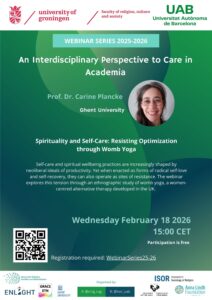
“Spirituality and Self-Care: Resisting Optimization through Womb Yoga”, by Carine Plancke

Self-care and spiritual wellbeing practices are increasingly shaped by neoliberal ideals of productivity. Yet when enacted as forms of radical self-love and self-recovery, they can also operate as sites of resistance. The webinar explores this tension through an ethnographic study of womb yoga, a women-centred alternative therapy developed in the UK.

Prof. Carine Plancke is Guest Professor in Gender and Diversity Studies and directs the Centre for Research on Culture & Gender at Ghent University. She holds a MA in Social and Cultural Anthropology (KU Leuven), a postgraduate in Women’s Studies (University of Antwerp.) and a PhD in Social and Cultural Anthropology (Ecole des hautes études en sciences sociales, Paris / KU Leuven.) She worked as a teaching and research fellow at the universities of Nice and Clermont-Ferrand, as a Fernand Braudel and a Marie Curie fellow at the University of Roehampton and as a FWO postdoctoral researcher at Ghent University. Her research areas are anthropology, gender, body practices, dance, performance, yoga, tantra, affect, ritual and creativity, contemporary spirituality, Central Africa, Western Europe.

This webinar is the first in 2026 webinar series “Care in Academia: An Interdisciplinary Perspective” , organized by the GRACE-ETN: Globalization, Religion and Culture Educational Thematic Network.

Registration: https://docs.google.com/forms/d/e/1FAIpQLScTejWlkpgpOcSrN11mFChTV5erQPlbT4BU6nzm_psK75E8HQ/viewform 

GRACE - ETN Logo

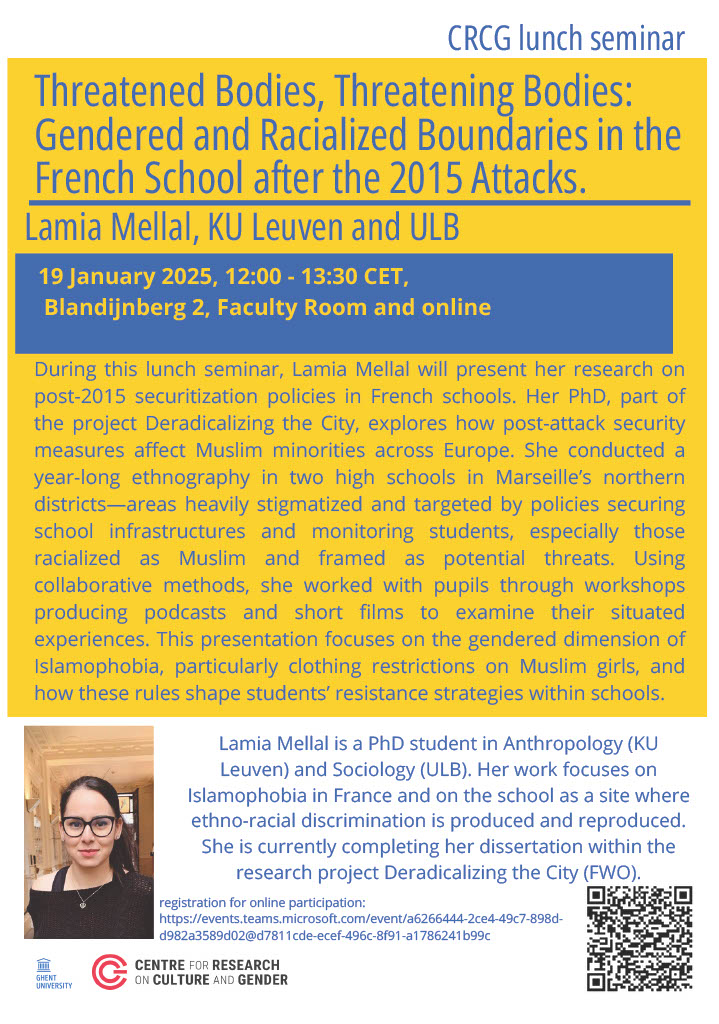
Threatened Bodies, Threatening Bodies: Gendered and Racialized Boundaries in the French School after the 2015 Attacks

During this lunch seminar, Lamia Mellal will present her research on post-2015 securitization policies in French schools. Her PhD, part of the project Deradicalizing the City, explores how post-attack security measures affect Muslim minorities across Europe. She conducted a year-long ethnography in two high schools in Marseille’s northern districts—areas heavily stigmatized and targeted by policies securing school infrastructures and monitoring students, especially those racialized as Muslim and framed as potential threats. Using collaborative methods, she worked with pupils through workshops producing podcasts and short films to examine their situated experiences. This presentation focuses on the gendered dimension of Islamophobia, particularly clothing restrictions on Muslim girls, and how these rules shape students’ resistance strategies within schools.

Lamia Mellal is a PhD candidate in Anthropology (KU Leuven) and Sociology (ULB). Her work focuses on Islamophobia in France and on the school as a site where ethno-racial discrimination is produced and reproduced. She is currently completing her dissertation within the research project Deradicalizing the City (FWO).

Registration for online participants:

CRCG lunch seminar with Lamia Mellal – Threatened Bodies, Threatening Bodies: Gendered and Racialized Boundaries in the French School after the 2015 Attacks. | Meeting-Join | Microsoft Teams


Lamia Kocaman: From Modern Couches to Cosmopolitan Villages: Migrant Women’s Transnational Home-Making Between Europe and Turkey

During this lunch seminar, Lamia Kocaman will present her research on transnational home-making between Europe and Turkey, focusing on amplifying women’s voices. Her work examines how migrant women actively shape their multiple homes across borders and negotiate multiple belongings. By analyzing both the processes and products of home-making, Kocaman explores how transnational houses challenge traditional, static notions of the home. These houses are both fixed in place and shaped by their connections elsewhere. Using a transnational framework, her research highlights the circulation of spatial knowledge, practices, and aesthetics between European cities (cities of residence Ghent and Stockholm) and Turkish towns (cities of origin: Emirdağ and Kulu). Through in-depth interviews and spatial mapping, Kocaman amplifies the voices of women who often remain underrepresented in architectural and urban studies. Her work intersects architecture, anthropology, and feminism, offering new insights into how migration impacts domestic spaces across borders and landscapes.

Lamia Kocaman is a PhD student in the Department of History, Theory, and Criticism of Architecture at KU Leuven. She is currently working on a dissertation titled Transnational Housing: A Spatial Analysis of the Processes and Products of Migrant Women’s Home-Making Between Europe and Turkey (supervised by Luce Beeckmans).

‘Was I not enough?’ Infidelity and the crisis of the self, by Simone Schneider

12.00h-13.30h, on-campus
Blandijn room 3.30 – Camelot (third floor) Campus Boekentoren, Blandijn Blandijnberg 2, Ghent University

In this lunch seminar, Simone Schneider will present her work on infidelity in intimate relationships, drawing on qualitative interviews with people in and around London who have personal experiences of cheating, relationship transgressions, and affairs.

What is it like when your partner cheats on you? How do people negotiate and manage this experience? In this presentation, Simone will focus on the accounts of those who have been cheated on or whose partner has had an affair. She argues that infidelity calls into question individuals’ sense of self and their (couple) identity, in particular, in light of contemporary ideas around choice, recognition, and (anticipated) stigma. Against this background, Simone examines the various forms of identity and recognition work that people engage in when dealing with infidelity. Namely, different narratives and strategies allow them to restore their sense of self, self-worth, and agency. Finally, she links this analysis to broader discussions on gender and sexual identity, the role of romantic relationships, as well as singularity and ordinariness.

Simone Schneider is a PhD student in the Department of Sociology at the University of Cambridge. Her research explores cultural and social processes in the realms of intimacy and sexuality. In her dissertation, Simone studies the meanings, norms, and practices of infidelity in intimate relationships.


Tuesday 16 September 2025
12h00 – 13h30 


Join us in person, no registration required
Blandijn room 3.30 – Camelot (third floor)
Campus Boekentoren
Blandijn Blandijnberg 2
9000 Ghent